
Size guides help customers identify their correct measurements and clothing dimensions before purchase, while fit comparisons evaluate how different brands or styles perform against each other in terms of comfort and silhouette. Size guides excel at providing standardized measurements and conversion charts, whereas fit comparisons shine at highlighting real-world differences between options. This page examines how these tools work together to help shoppers make informed decisions.
Key takeaways:
- Size guides provide standardized measurements, conversion charts, and dimensional references specific to each brand or product category
- Fit comparisons evaluate how garments perform across different body types, fabrics, and style variations
- Using both tools together reduces return rates and improves purchase confidence
- Different brands often size differently, making direct comparisons essential for accurate selection
- Fit feedback from multiple sources provides more reliable guidance than single-source recommendations
Size guides and fit: at a glance
Who each approach serves
Size guides and fit comparison matters because the wrong fit wastes money, time, and frustration. The core question is simple: which sizing method matches your body type and shopping habits? Some people need precise measurements before they buy. Others rely on how a garment feels in their hands or on their frame. The one difference that decides most cases is whether you trust standardized charts or prefer real-world feedback from people with similar builds.
Traditional manufacturer size charts work best for shoppers who know their measurements and prefer consistency. They're useful when you've worn a brand before and remember how it fit. Comparison-based fit systems work better for first-time buyers or anyone shopping across multiple brands. They show you how sizes differ between makers, so you can spot when one brand runs large or small.
The axes that matter
Five criteria separate sizing approaches and help you pick the right one for your needs:
| Criterion | Manufacturer Size Charts | Fit Comparison Systems |
|---|---|---|
| Measurement method | Chest, waist, length, and sleeve length in inches or centimeters. You measure yourself or use a garment you already own. | Side-by-side comparisons showing how the same labeled size fits across brands. Includes fit notes like "runs small" or "generous in the chest." |
| Best for first-time use | Requires you to know your measurements or have a reference garment. Slower if you're unfamiliar with the brand. | Faster for new shoppers. You see how Brand A's medium compares to Brand B's medium without measuring yourself. |
| Accuracy across brands | Consistent within one maker but varies widely between makers. A size M from one label may differ from another's M by 2–3 inches. | Accounts for brand-to-brand differences. Helps you avoid surprises when switching between manufacturers. |
| Data source | Provided by the manufacturer. Based on their production standards and target customer. | Compiled from customer reviews, returns data, or direct measurement comparisons. Reflects real-world fit patterns. |
| Time to find your size | Quick if you know your measurements. Slower if you need to measure or hunt for a reference garment. | Quick for most shoppers. Scan the comparison and pick the size that matches your usual fit. |
How to choose which one to use
Follow these steps to pick the sizing method that fits your situation:
- Check if you've worn this brand before: If yes, use the manufacturer chart and order the same size. Brands rarely change their fit standards year to year.
- Know your measurements: If you've measured yourself or have a well-fitting garment, the manufacturer chart is your fastest route. Compare the garment's measurements to the chart.
- Shopping across new brands: Use a fit comparison system. It shows you which brands run tight or loose, saving you from ordering the wrong size.
- Unsure about your measurements: A comparison system works better. You can match your usual size to how other shoppers describe the fit.
- Buying from a discount or outlet brand: Use both. Check the manufacturer chart first, then cross-reference with comparisons to similar mainstream brands. Fit can shift in lower-cost lines.
The deciding factor
Consistency matters most. If a brand fits you well, stick with its size chart. If you're exploring new brands or jumping between price points, a comparison system saves time and reduces returns. The best approach uses both: measure yourself once, then use that baseline to read comparison charts across brands.
Features compared
Data collection and input method
Size guides and fit comparison tools differ fundamentally in how they gather customer body measurements. Traditional static size guides rely on pre-defined charts—usually organized by brand, region, or garment type—that customers consult manually. A shopper reads a chart, finds their chest measurement in one column, then traces across to locate their recommended size. This approach requires the customer to know their own measurements beforehand and to interpret the guide correctly.
Interactive fit comparison systems, by contrast, collect measurements through guided input. They ask customers to enter specific dimensions (inseam, sleeve length, shoulder width) or answer fit-preference questions ("Do you prefer a loose or fitted cut?"). Some capture this data through a series of structured steps rather than a single lookup. This distinction matters because guided input can prompt for measurements a customer might not have considered, reducing guesswork.
Measurement scope and depth
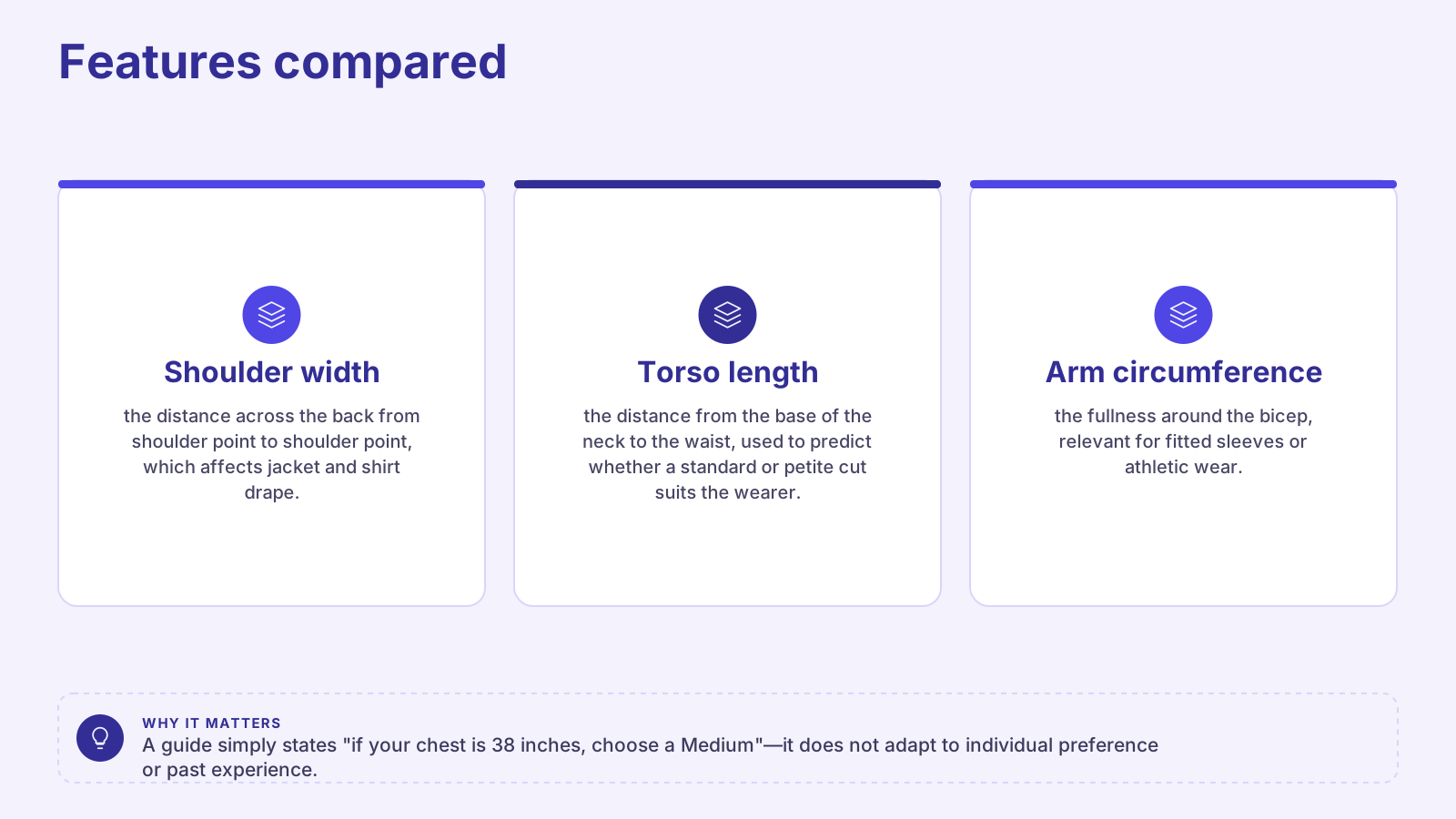
A key difference lies in how many body points each approach measures. Static guides typically cover three to five key dimensions: chest, waist, inseam, and sometimes sleeve length. They prioritize the measurements most relevant to fit for a given garment category. Fit comparison systems often expand this scope. They may request:
- Shoulder width: the distance across the back from shoulder point to shoulder point, which affects jacket and shirt drape.
- Torso length: the distance from the base of the neck to the waist, used to predict whether a standard or petite cut suits the wearer.
- Arm circumference: the fullness around the bicep, relevant for fitted sleeves or athletic wear.
- Thigh and knee measurements: for pants fit beyond just inseam, capturing how snug or loose the leg will feel.
This depth allows fit comparison tools to flag mismatches a size chart alone might miss. However, it also demands more effort from the user and requires the retailer to maintain detailed size specifications for each product.
Comparison across products and brands
Static size guides work within a single brand or retailer's ecosystem. A customer uses one guide for Brand A and a different guide for Brand B. Switching between guides is manual and time-consuming.
Cross-brand fit comparison is where interactive systems show their strength. They can store a customer's measurements once, then apply them to products from multiple brands simultaneously. This capability reveals that a Medium from one brand may fit like a Small from another—a discovery that static guides cannot support without the customer manually checking each brand's chart. The system acts as a translation layer between different sizing standards.
Fit prediction and personalization
Size guides provide a recommendation based on measurement alone. Fit comparison systems can layer additional logic on top. They may adjust recommendations based on fabric type (a stretchy knit fits differently than rigid denim), garment style (a slim-fit shirt needs different dimensions than a relaxed cut), or customer feedback history (if a customer previously reported that Brand X runs small, the system flags future Brand X purchases).
This personalization is absent from static guides, which treat all customers identically. A guide simply states "if your chest is 38 inches, choose a Medium"—it does not adapt to individual preference or past experience.
Pricing compared
How pricing models differ
Size guides and fit comparison services charge in fundamentally different ways. Some use a per-transaction model, charging each time a customer accesses a fit tool or comparison. Others employ a subscription model, where retailers pay a fixed monthly or annual fee regardless of usage volume. A third approach uses tiered licensing, where cost depends on the number of products catalogued or the volume of monthly transactions. Understanding which model applies to your business helps predict costs as you scale.
The choice of pricing model creates different cost curves. At small scale—say, 100 daily fit comparisons—per-transaction pricing often appears cheapest. At medium scale (1,000 daily comparisons), subscription models frequently become more economical. At large scale (10,000+ daily comparisons), tiered licensing with volume discounts may offer the best value. The break-even point where one model becomes cheaper than another typically falls between small and medium usage levels.
Small-size scenario: Early-stage retailers
A new clothing brand with one product line and modest traffic faces different economics than an established player. Per-transaction pricing works well here because usage stays low and predictable. A subscription model feels expensive relative to actual need. However, some providers set minimum monthly fees even under subscription models, which can burden small operators. Tiered licensing rarely applies at this stage, since minimum product counts are usually too high.
Medium-size scenario: Growing multi-category retailers
Once a retailer offers multiple product lines and attracts steady traffic, the math shifts. Monthly transaction volumes climb into the hundreds or low thousands. At this point, subscription pricing often undercuts per-transaction costs. Tiered licensing becomes relevant if the provider charges based on product count. A retailer comparing 500 products across five categories may hit a tier threshold that raises costs noticeably.
Large-size scenario: Enterprise retailers
High-volume retailers with thousands of SKUs and millions of monthly fit queries need different terms. Per-transaction pricing becomes prohibitively expensive. Subscription models require negotiation for volume discounts. Tiered licensing with negotiated rates typically offers the best fit. Enterprise providers often bundle size guides and fit comparison with other tools—inventory sync, analytics, or customer data integration—creating package pricing rather than standalone costs.
What is and is not included
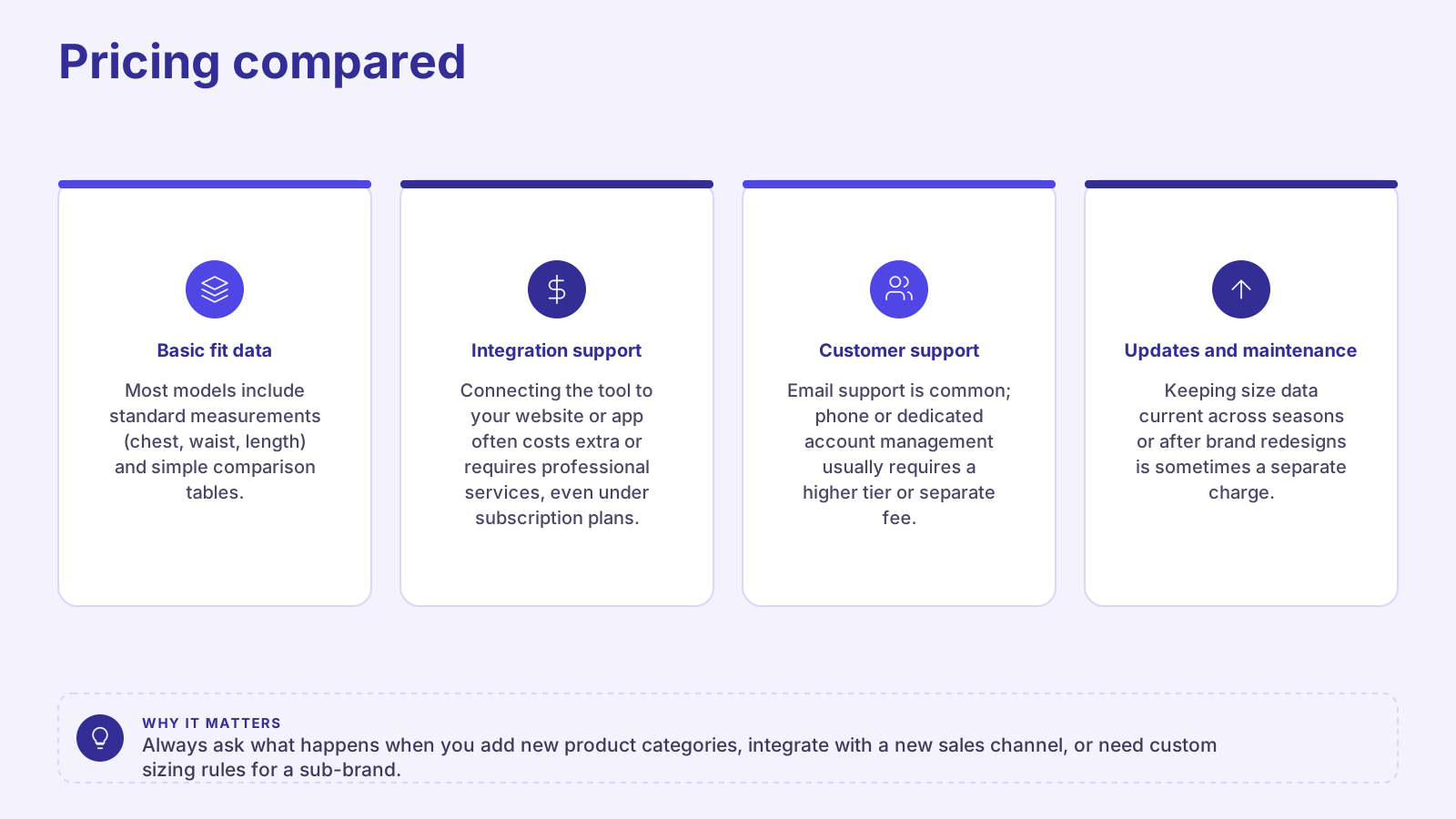
- Basic fit data: Most models include standard measurements (chest, waist, length) and simple comparison tables. Custom brand-specific sizing rarely comes standard.
- Integration support: Connecting the tool to your website or app often costs extra or requires professional services, even under subscription plans.
- Customer support: Email support is common; phone or dedicated account management usually requires a higher tier or separate fee.
- Historical data and analytics: Tracking which size comparisons customers view most often may be excluded or offered only at enterprise tiers.
- Updates and maintenance: Keeping size data current across seasons or after brand redesigns is sometimes a separate charge.
Comparing pricing requires clarity on what each model covers. A cheap per-transaction rate means nothing if integration fees triple the real cost. A flat subscription sounds simple until you discover analytics cost extra. Always ask what happens when you add new product categories, integrate with a new sales channel, or need custom sizing rules for a sub-brand.
Ease of use and setup
The speed at which you can generate meaningful results—what teams call time to first value—varies significantly depending on which size guide or fit comparison tool you choose. Some solutions let you start comparing fits within minutes. Others require days of preparation before you see your first useful output. Understanding what setup actually involves helps you pick the right approach for your timeline and resources.
Getting started with basic size guides
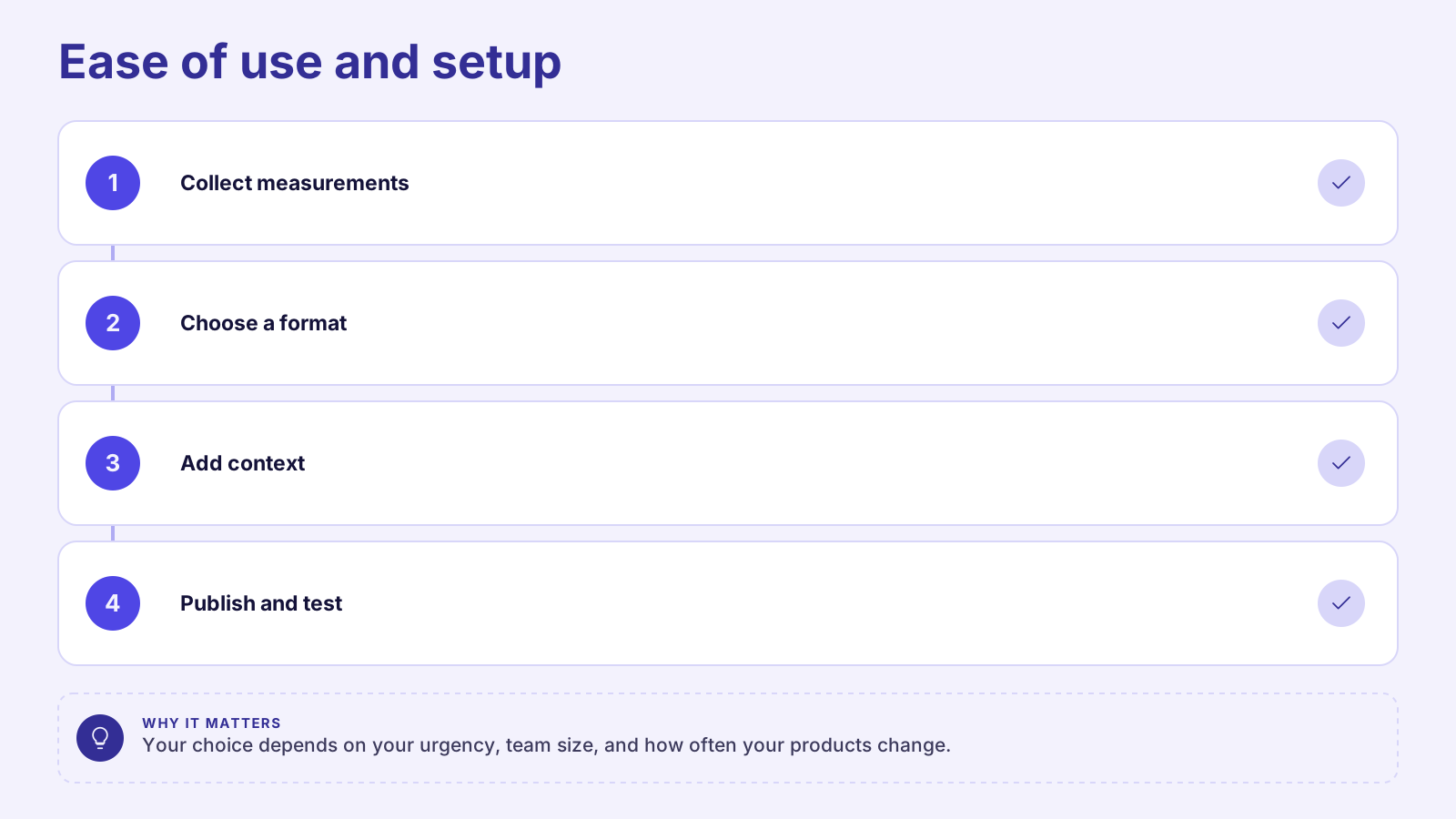
Traditional static size guides—charts showing chest width, sleeve length, and inseam measurements—require minimal setup. You gather your brand's measurements, organize them by size, and publish. The learning curve is nearly flat. Most teams complete this work in a few hours to a day. The typical process involves these steps:
- Collect measurements: Pull data from your sample garments, pattern grading sheets, or existing product specs. Write down every dimension relevant to fit—shoulder width, torso length, armhole depth, and any other key points customers care about.
- Choose a format: Decide whether you'll show measurements as a simple table, a visual diagram, or both. Tables work well for detailed numbers. Diagrams help visual learners spot differences quickly.
- Add context: Write brief notes explaining what each measurement means and how it affects the wearing experience. For example, note whether a garment runs tight or loose in the shoulders.
- Publish and test: Put your guide live and ask customers for feedback. Refine based on real returns and complaints.
This straightforward approach means you avoid complex software, training sessions, or technical configuration. The tradeoff: static guides don't adapt to new products or customer body types without manual updates.
Comparative fit tools and their setup demands
Fit comparison systems—tools that show how one product differs from another, or how a size runs relative to industry standards—usually demand more upfront work. You'll need to input data into a structured system, often through spreadsheets or API connections. Setup typically takes days to weeks, depending on your product catalog size and data quality. Key setup tasks include:
- Data standardization: Ensure all measurements use the same units, are taken at the same points on each garment, and follow consistent naming rules. Mismatched data leads to confusing or incorrect comparisons.
- Integration with your system: Connect your product database, inventory platform, or e-commerce backend so fit data updates automatically when products change. Manual syncing is error-prone and time-consuming.
- Testing and validation: Run sample comparisons against real customer feedback. If your tool says a shirt runs small but customers report it fits true to size, your underlying data is wrong.
- Team training: Teach your merchandising, customer service, and marketing teams how to read and explain the comparisons to shoppers.
Once configured, comparative tools save time on ongoing updates and provide richer information to customers. The initial investment is steeper, but the payoff grows as your catalog expands.
Choosing based on your constraints
If you need results in days and your product range is small, a basic size guide is faster. If you manage hundreds of SKUs and want fit data to stay current without manual work, a comparative system justifies its setup complexity. Your choice depends on your urgency, team size, and how often your products change.
Where Size guides and fit wins
Size guides and fit comparison becomes your best tool when you face a specific, concrete problem: you need to choose between options that differ meaningfully in how they measure, what they cover, or how they apply to your body or use case. This section names those situations clearly so you can recognize when this approach will actually solve your problem.
When you're buying across brands or categories
If you're shopping for clothing, shoes, or fitted gear from multiple manufacturers, size guides and fit comparison is essential. Brands use different sizing standards—the actual measurements behind a "medium" or "size 9"—so a medium from one maker may fit like a small or large from another. A size guide tells you the chest width, sleeve length, or inseam for each size. Fit comparison means placing those numbers side by side to see which brand's medium actually matches your measurements.
For example: You wear a size 32 in one jean brand but need to know what size works in a different brand. You measure your inseam (the inside seam of your pant leg, from crotch to ankle) as 30 inches. You pull up size guides for both brands, find the inseam listed for each size, and spot that Brand A's size 32 has a 30-inch inseam while Brand B's size 32 has a 31-inch inseam. Now you know to order Brand B in a size 31 instead.
When fit matters more than price or brand loyalty
Size guides and fit comparison wins when comfort and proper fit are worth your time. If a garment or shoe fits poorly, you won't wear it—making the lower price or familiar brand name irrelevant. This approach forces you to prioritize the actual fit over habit or marketing. Follow this step-by-step process:
- Take your own measurements: Use a soft tape measure and measure the parts that matter most—chest, waist, inseam, or foot length. Measure yourself in light clothing, standing straight, and have someone help if possible.
- Gather size guides from each option: Download or screenshot the official size chart from each brand or retailer you're considering.
- Map your measurements to each guide: Find the row or size that matches your measurements most closely in each chart.
- Note the gaps: Write down which brand is closest to your measurements and which one is furthest off. A half-inch difference in sleeve length matters; a quarter-inch usually doesn't.
- Read fit notes: Check if the brand describes the fit as "slim," "relaxed," or "true to size." These notes explain how the actual garment feels, not just its measurements.
When you're a non-standard size
If you fall outside typical size ranges—very tall, very short, larger, or smaller than average—size guides and fit comparison becomes your defense against poor fits. Standard sizing often leaves you with sleeves that are too short or pants that bunch at the ankle. By comparing actual measurements across brands, you can find the one that comes closest to your proportions rather than guessing or settling for bad fit.
Where wins
Size guides excel at standardization
Size guides provide a single, consistent reference point across an entire product line or brand. When a manufacturer publishes measurements—chest width, sleeve length, inseam—customers can compare those numbers directly to garments they already own. This works especially well for basics like t-shirts, jeans, and hoodies, where fit expectations are narrow and predictable. A customer who knows their chest measurement can pick the right size without trying anything on.
The standardization also means less back-and-forth. Once you understand a brand's sizing system, you can shop faster and with more confidence. Retailers benefit too: fewer returns due to size confusion reduce costs and improve customer satisfaction.
Fit comparison wins on real-world variation
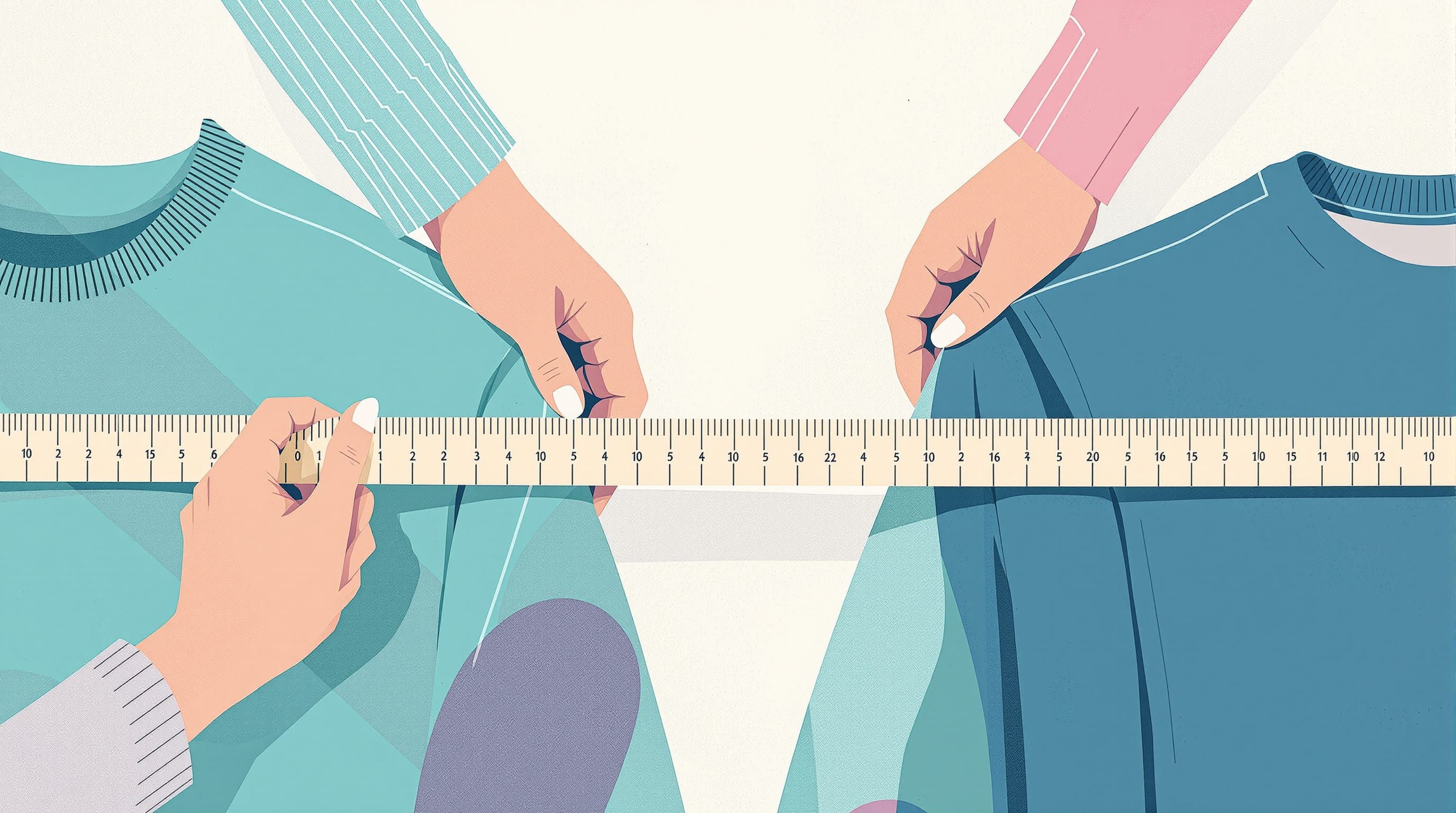
Fit comparison—placing items side by side to show how they differ—handles the messy truth that identical sizes fit differently across styles. A medium sweater and a medium button-up from the same brand may have completely different sleeve lengths or shoulder widths. Fit comparison shows this directly. Instead of guessing, a customer sees that one style runs tight through the shoulders while another runs loose. This approach shines for:
- Cross-category shopping: comparing how a medium fits in dresses versus blazers versus knitwear, where construction methods vary widely.
- Brand-to-brand decisions: showing how one brand's medium compares to another brand's medium, which helps customers switching between labels.
- Fabric and cut effects: demonstrating that stretchy fabrics fit differently than rigid ones, even at the same labeled size.
Size guides work best with limited, predictable products
When a brand sells only a few core styles—or when styles are engineered to fit identically—a single size guide often suffices. Workwear, uniforms, and basic athletic wear often fall into this category. The simplicity is an asset. A customer doesn't need to compare; they just measure and select.
Fit comparison handles complexity better
The reverse is also true. Brands with dozens of silhouettes, seasonal collections, or varied fabric weights find that fit comparison absorbs complexity that a single size guide cannot. Rather than writing separate guides for each style—which becomes unwieldy—fit comparison lets customers see the actual differences in one view.
The tradeoff is effort. Fit comparison requires more data collection and visual presentation work. But when a brand's catalog is large or varied, that investment pays off in fewer customer complaints and returns.
Size guides and fit: which should you choose?
The choice between relying on a size guide and testing actual fit depends on your situation, shopping habits, and tolerance for returns. Neither approach is universally superior. The right pick depends on what you're buying, how much time you have, and whether you've shopped with a brand before.
Pick size guides if…
You're buying from a brand you know well and have purchased from successfully before. If a retailer's sizing has been consistent across multiple purchases, their size chart—which shows measurements for bust, waist, inseam, or sleeve length in inches or centimeters—becomes a reliable shortcut. You can match your own measurements to the chart and order with confidence.
You're shopping under time pressure or cannot easily return items. Size guides let you make a single, informed decision without waiting for a package to arrive. This matters when you need clothing for an event in two weeks or live far from a return center.
You're buying basics in a familiar category. A white cotton t-shirt or plain jeans from a consistent manufacturer often follows predictable sizing. If you've worn size Medium from a brand before, the next Medium will likely fit similarly. Here's a practical step for using size guides effectively:
- Measure yourself accurately: Use a soft measuring tape around your chest, waist, or hips while wearing minimal clothing. Record the measurement in the same units (inches or centimeters) as the chart.
- Find your measurement on the chart: Locate the row that matches your measurement, not the size label you typically wear.
- Check multiple dimensions: If buying a dress, compare bust and length. If buying pants, match both waist and inseam.
- Read any notes: Many guides include comments like "runs small" or "generous fit," which adjust your expectations.
Pick fit testing if…
You're buying from a new brand, an unfamiliar category, or a style that's outside your usual range. When you have no prior experience with a retailer's fit standards—the actual way their garments drape and feel on real bodies—a size guide alone cannot predict how a dress, jacket, or pair of shoes will work for you. Ordering multiple sizes or trying items in-store removes guesswork.
You value comfort over speed. If you're willing to wait for delivery and process a return, trying on clothes lets you assess not just size but also fabric weight, stretch, and how seams sit on your body. This is especially important for investment pieces like coats or formal wear.
You have an unusual body shape or fit concerns. Standard size charts assume average proportions. If you're significantly taller, shorter, curvier, or broader than the average person in your size range, fit testing helps you spot potential problems before committing to a purchase.
When neither is right
If you face frequent fit failures despite using size guides, or if returning items is expensive or inconvenient, consider a third option: customer reviews with photos. Real shoppers often post images showing how items fit their bodies and note whether sizing ran large, small, or true. This hybrid approach combines the convenience of a guide with the realism of fit feedback.
Frequently Asked Questions
What is the difference between a size guide and a fit comparison?
A size guide provides specific measurements and dimensional data for a particular item or brand, helping you identify your correct size. A fit comparison evaluates how different brands, styles, or cuts perform relative to each other, highlighting whether something runs large, small, or true to size.
Why do different brands size differently?
Brands use different manufacturing standards, target different body types, and source from various suppliers, resulting in inconsistent sizing across the industry. A medium from one brand may fit very differently than a medium from another, making comparisons necessary.
How should I use a size guide to find my correct size?
Measure yourself using the specific points outlined in the size guide (chest, waist, length, etc.), then match your measurements to the corresponding size range. Always use the brand's own guide rather than assuming your usual size will apply.
What information should a good fit comparison include?
A quality fit comparison addresses how a garment fits across different areas (shoulders, chest, waist, length), whether it runs true to size or differently, and how it compares to similar items from other brands or previous versions.
Can I rely solely on size guides or fit comparisons when shopping online?
Using both together provides the most reliable approach. A size guide tells you what to order, while fit comparisons help you understand how that size will actually feel and whether it suits your preferences for a tighter or looser fit.
Final thoughts
Size guides and fit comparisons serve complementary purposes in online shopping—one tells you what to order, the other helps you understand how it will actually fit. Before your next purchase, check both the brand's official size guide for your measurements and any available fit comparisons to see how customers with similar preferences experienced the garment. This two-step approach significantly increases the likelihood of getting a piece that fits your needs.
Further reading
These related pages were checked for availability and topic relevance. Their presence does not verify every claim in this article.
- Clothing sizes - Wikipedia — en.wikipedia.org
Powered by AutoSEO — AI SEO content on autopilot.